
Mission-critical procurement compresses vendor onboarding for one reason: a material supplier delivers a product to the site, and doesn’t send labor to it. When a mission-critical job needs a new roof curb supplier added mid-schedule, the vendor-add for that supplier typically runs about five business days of admin, not the multi-week prequalification cycle a new subcontractor triggers.
That distinction is procurement mechanics, not marketing. It matters because on a fast-track data center or hospital build, “we need to add a supplier” can sound like a schedule problem before anyone checks whether it actually is one.
Why does a material supplier move faster through procurement than a subcontractor?
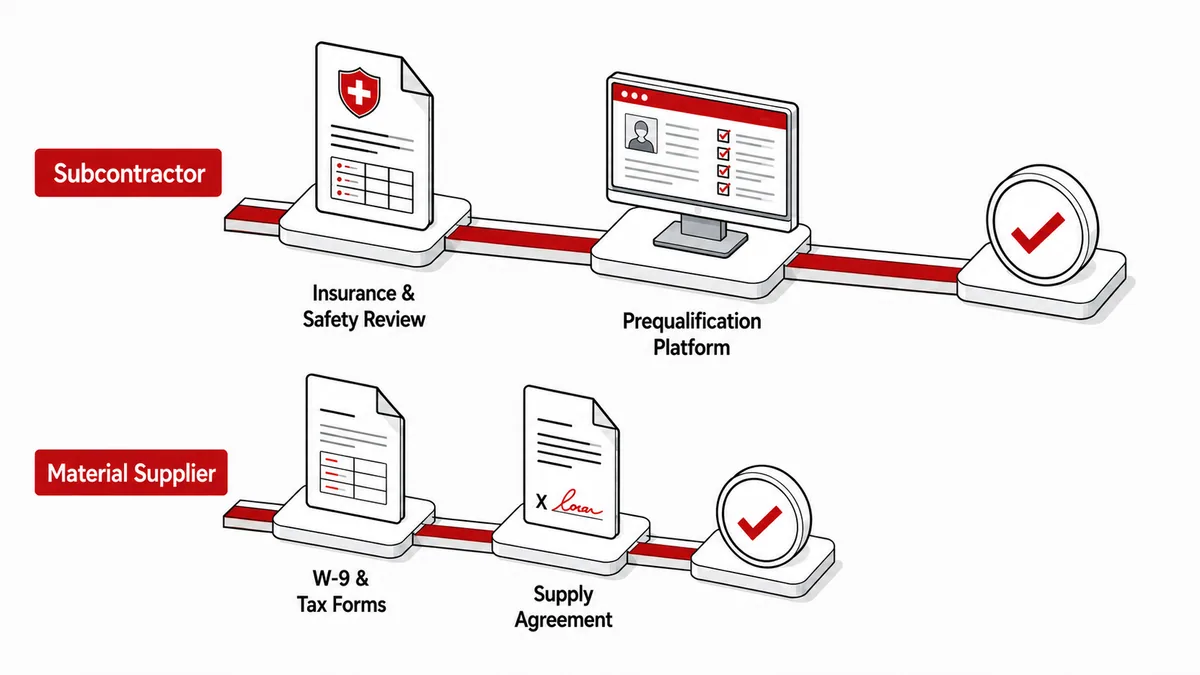
A subcontractor sends a crew to the site. That triggers the full risk-vetting stack: general liability and workers’ comp certificates, safety program review, OCIP/CCIP enrollment where the project carries one, and often a formal prequalification submission through a platform like Avetta or ISN. None of that exists to vet the product; it exists to vet the presence of another company’s workers on your site.
A material supplier does neither. Standard AGC contract documents (AGC Document 200 and 415) treat “Subcontractor” and “Material Supplier” as two distinct, separately-bound categories for exactly this reason: the obligations that follow site labor don’t apply to a company that only ships a fabricated product to a dock. The onboarding that remains is administrative: tax documentation, payment terms, and a signed agreement. The full legal and contractual distinction, and where it breaks down if a supplier also provides field supervision, is its own topic; this post covers the timeline it produces.
What does the 5-day vendor-add protocol actually include?
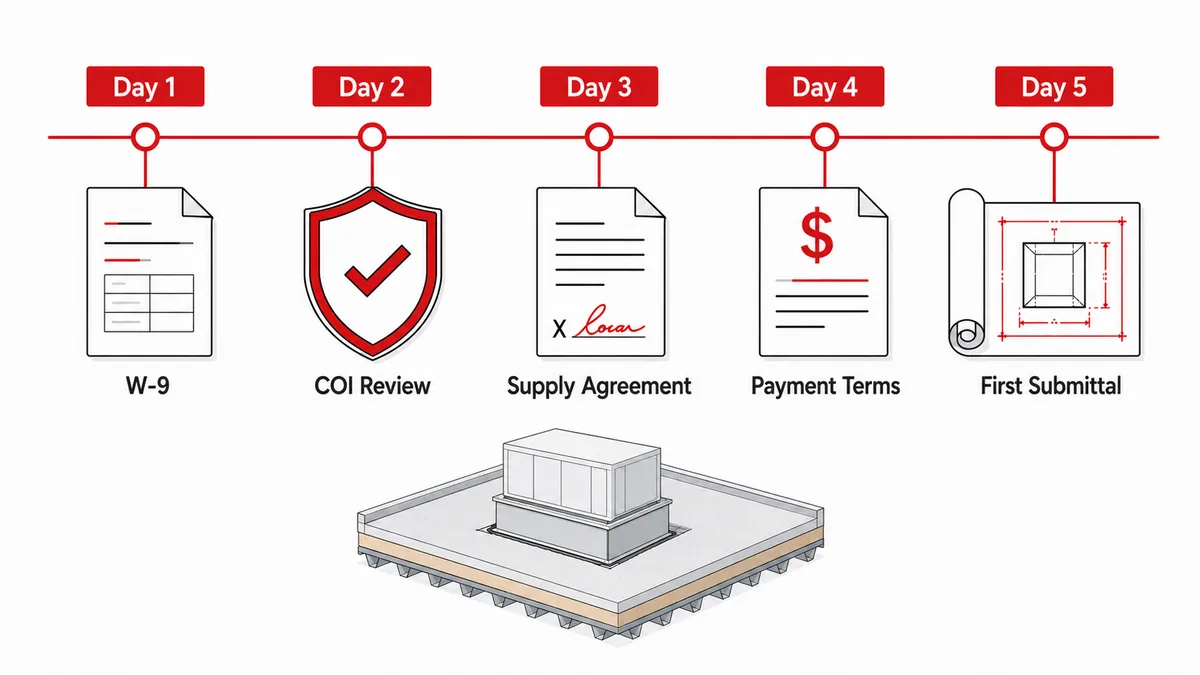
Five business days is the typical span from “add this vendor” to “first submittal in review,” assuming the supplier already has a quote on file. The table below is the artifact checklist, not a generic reassurance.
| Day | Artifact | Who owns it |
|---|---|---|
| 1 | W-9 and business entity verification | Supplier → GC accounting |
| 2 | Certificate of insurance review: product liability only, no GL/workers’ comp/COI stack required the way a sub’s would be | GC procurement |
| 3 | Signed supply agreement or purchase agreement (not a subcontract) | Both parties |
| 4 | Payment terms confirmed: Net 30, Net 45, or pay-when-paid clause named explicitly | GC accounting |
| 5 | First submittal package released for design review | Supplier |
Industry vendor-onboarding data outside construction shows a general range of four to six weeks for full onboarding, with well-organized teams completing it in under two weeks, per a 2026 construction vendor-onboarding benchmarking report. That range describes the fuller subcontractor-style process. A material-supplier vendor-add is a fraction of it, precisely because it skips the safety-and-insurance-vetting steps that consume most of that timeline.
What information speeds this up on your end?
The five-day window assumes the GC hands the supplier a complete package on day one, not a partial one that triggers a back-and-forth. Three things determine whether it holds:
- Project scope summary: the building type, roof condition, and general timeline, so the supplier isn’t guessing at fit.
- Equipment list: unit make/model and quantities, so the first submittal reflects real curb requirements instead of placeholders.
- Schedule: the actual need-by date for the first curb delivery, not a placeholder “ASAP.”
A vendor-add missing any of these doesn’t fail; it just adds a clarification cycle before day one effectively starts, which is the same failure mode that slows a subcontractor RFQ.
Why do mission-critical GCs prefer suppliers who can absorb this timeline?
Because on a compressed schedule, the curb sits on the critical path between structural completion and HVAC set, a fact this blog has covered before in the context of data center curb procurement. A supplier who can move through a 5-day vendor-add without pushing back doesn’t just save five days; they signal they’ve done this before, on schedules that don’t forgive delay. A supplier who treats the vendor-add like a subcontractor onboarding, asking for a safety manual, an EMR rating, a COI stack they don’t legally need, is telling the GC something about how they’ll handle the rest of the relationship.
Frequently Asked Questions
Does a curb supplier need to go through subcontractor prequalification?
No. As a material supplier, a curb fabricator doesn’t send labor to the site, so the insurance, safety, and OCIP/CCIP requirements built for subcontractors typically don’t apply; see our data center curb guide for how that shapes supplier screening more broadly.
What’s the difference between a supply agreement and a subcontract?
A supply agreement covers a product delivered to the site; a subcontract covers labor performed on it. The vendor-add paperwork follows that distinction: tax forms and payment terms for a supplier, versus the full insurance and safety stack for a subcontractor.
What can delay a 5-day vendor-add?
An incomplete initial package. Missing equipment specs, an undefined schedule, or unclear payment terms all trigger a clarification cycle before the timeline starts.
Does this apply to every material supplier, or just curbs?
The mechanism is general to material suppliers; it’s not curb-specific. What’s specific to mission-critical curb procurement is the schedule pressure that makes the five days matter: the curb sits on the critical path to HVAC set.
Can a supplier skip the vendor-add if they’ve worked with the GC before?
Usually yes, in shortened form. The tax and agreement paperwork is often already on file, leaving only a schedule and scope update for the new project.
Ready to add us as a supplier?
Send Custom Curb your project scope, equipment list, and schedule, and we’ll return a signed supply agreement and first submittal on a 5-day clock. Veteran-owned, family-operated, made in the USA.