
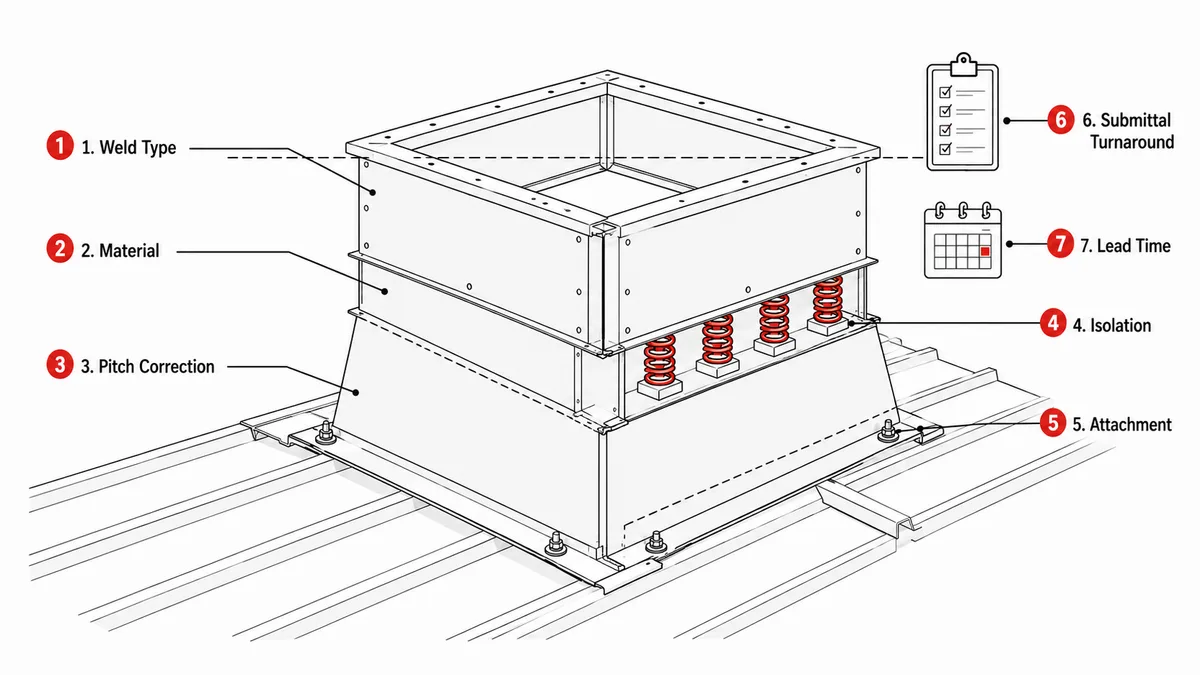
A mission-critical roof curb spec is complete when it states seven things in numbers, not adjectives: weld type, material, pitch correction, isolation, attachment, submittal turnaround, and lead time. On a Tier-3 data center build, a curb spec missing any one of these isn’t incomplete on paper: it’s a schedule risk waiting to surface at the worst possible review cycle.
Here’s what each item should say, why it matters at Tier-3 reliability stakes, and the red flag that tells you it’s missing.
What does Tier-3 actually ask of a roof curb?
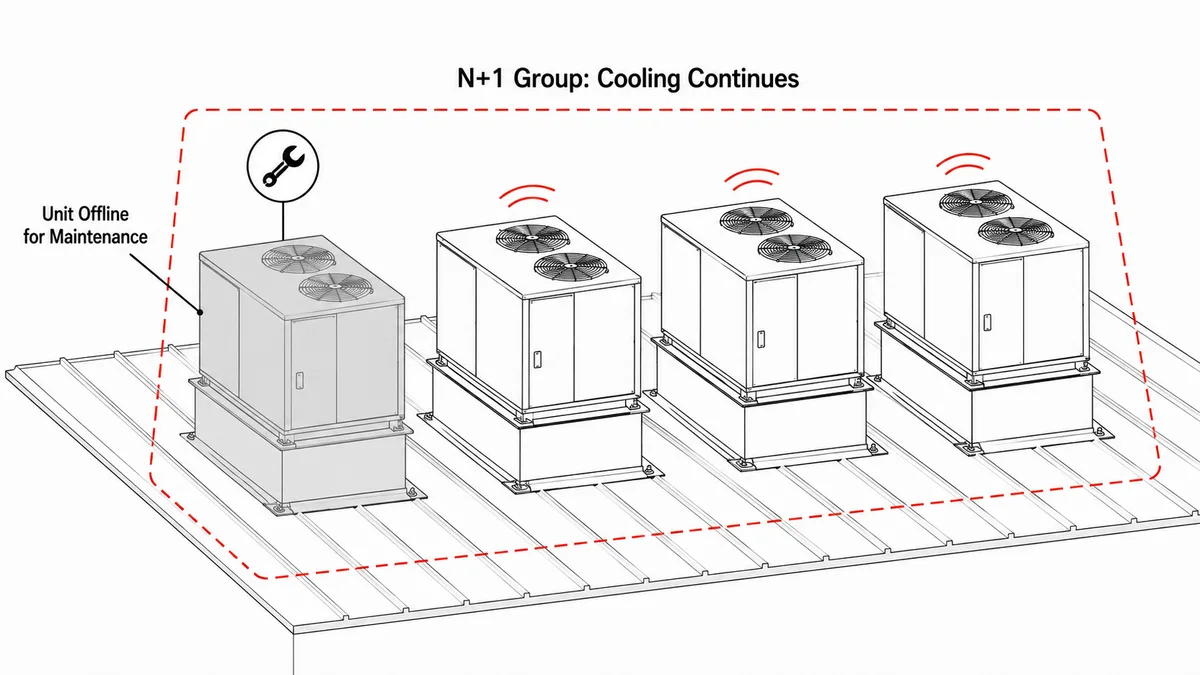
Uptime Institute’s Tier III standard requires concurrent maintainability: any capacity component can be taken offline for maintenance without affecting operations. For rooftop HVAC, that typically means N+1 redundancy, at least one extra cooling unit beyond the minimum the load requires. N+1 is not the same as 2N (full system redundancy); the distinction matters because N+1 means more units on the same roof, running continuously while adjacent units cycle through maintenance. More running units means more vibration sources near a building whose entire value proposition is uptime, which is why isolation and attachment aren’t optional line items on a Tier-3 spec the way they might be on a standard commercial roof.
The 7-point checklist
| # | Item | Why it matters at Tier-3 | Red flag |
|---|---|---|---|
| 1 | Weld type | Continuous vibration cycling works at any weld discontinuity over the equipment’s service life. Sheet-steel curb welds are governed by AWS D1.3, the Structural Welding Code for Sheet Steel. | Spec doesn’t name a weld standard, or treats stitch/spot welding as equivalent to fully welded |
| 2 | Material | Galvanized steel is the load-bearing choice for heavy, continuously-running rooftop units. ASTM A653 sets the gauge and coating standard. | Gauge or coating weight isn’t stated as a number; “heavy-duty” is not a spec |
| 3 | Pitch correction | Most mission-critical mechanical yards sit on pre-engineered metal building roofs with real slope, and an out-of-level curb passes that condition straight into the equipment. | Supplier can’t state a top-plate tolerance, only “custom-fit” |
| 4 | Isolation | N+1 means more units running near sensitive structure; isolation has to be sized to each unit’s actual operating frequency, not a generic curb | Isolation curb quoted with no deflection figure tied to the specific unit |
| 5 | Attachment | Curb-to-roof attachment has to be engineered to the project’s wind and seismic design criteria per ASCE 7. | Anchor pattern is generic, not tied to deck type or the site’s wind/seismic category |
| 6 | Submittal turnaround | Mission-critical builds order dozens to hundreds of curbs as one package, so a turnaround slip on one submittal round compounds across every curb type behind it, not just the curb that’s late | “Standard turnaround” with no business-day number attached |
| 7 | Lead time | A quoted range means little until it’s tied to your specific order size and isolation scope. Custom mission-critical curbs commonly run 8–14 weeks, but volume and technical review both move that number. | The number was quoted before your quantity was confirmed, or it shifts once the PO is placed |
Two red flags the checklist won’t catch
A supplier who describes the curb itself as “Tier III-rated” is speaking imprecisely at best. Tier classification belongs to the facility, not a component. A supplier who doesn’t draw that distinction may not be reading your spec the way your reviewer will. And a supplier who quotes the same isolation-efficiency number across different unit models is quoting a shortcut: deflection has to be sized to each unit’s actual operating frequency, not applied as a flat spec across a project.
For the exact CSI 07 72 46 spec language to lock these seven items into a project spec, see our 12-phrase substitution guide. For the fuller set of questions to put directly to a supplier, see our data center curb guide.
Frequently asked questions
Does a roof curb itself carry a Tier rating?
No. Tier classification applies to the facility’s overall infrastructure, not to an individual component. A curb supports Tier III reliability by meeting the seven checklist items above; it isn’t separately certified.
How is a mission-critical curb spec different from a standard commercial one?
The seven categories above don’t change. What usually changes is how tightly each one is specified, plus a firmer written commitment on submittal turnaround and lead time. For the exact language to lock that in, see our CSI 07 72 46 phrase guide.
What’s the riskiest gap in a spec that otherwise looks complete?
Submittal turnaround and lead time left as “TBD” or “per manufacturer standard.” Every other item gets caught at design review; these two are the ones a GC discovers only once the curb is already on the critical path.
How many curb types does a Tier-3 build typically need to isolate?
It varies by build; our data center curb guide breaks down base curbs, spring isolation curbs, and equipment covers and how procurement should treat each differently.
What documentation should back up each checklist item?
Weld maps and mill certs for welding and material; stamped shop drawings for pitch correction and attachment (see our roof curb DWG guide for exactly what a compliant drawing set should show); and a written submittal-turnaround and lead-time commitment, not a verbal estimate.
Ready to check a spec before it goes to submittal?
Send us your unit specs and roof details, and we’ll return a quote that answers all seven points in writing.