
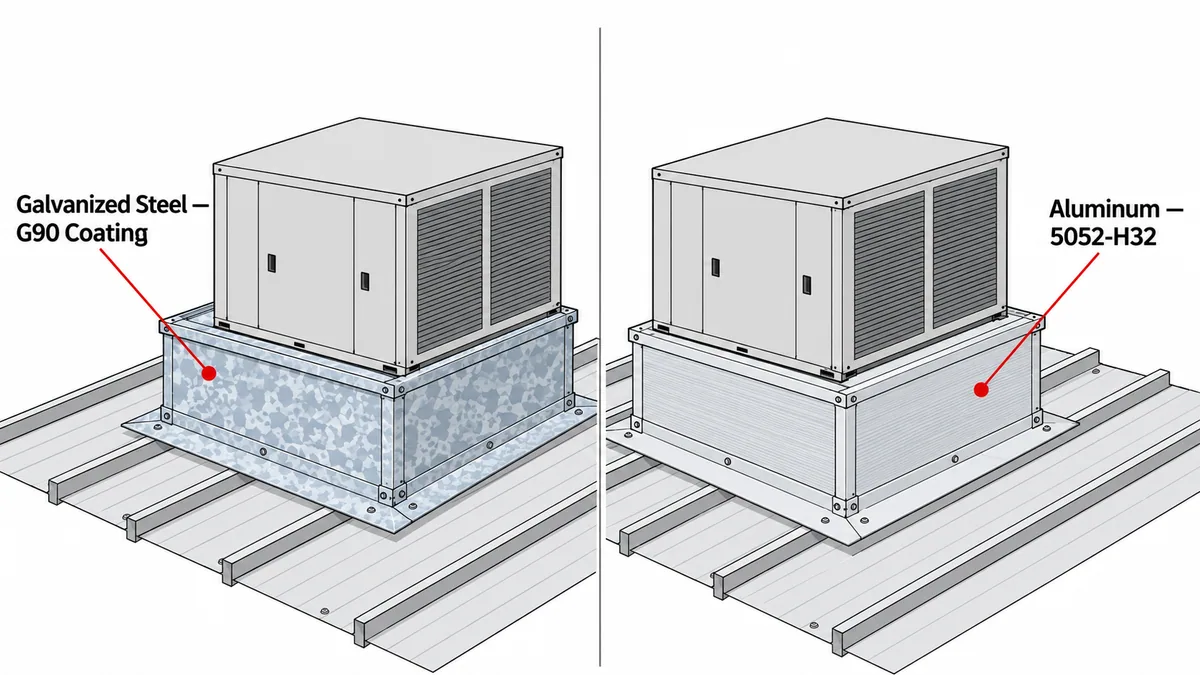
A galvanized steel roof curb is the material default for data center and mission-critical rooftop equipment because it’s a load-bearing structural element under a continuously-running unit: strength and section modulus matter more than weight or finish. Aluminum remains the right call on fully exposed metal-building roofs where appearance and corrosion resistance are the driving factors, not structural load.
Galvanized steel vs. aluminum roof curb at a glance
| Factor | Galvanized steel | Aluminum |
|---|---|---|
| Governing standard | ASTM A653 | ASTM B209 |
| Common alloy/coating | G90 (0.90 oz/ft² zinc, both sides) | 5052-H32 (forming), 6061-T6 (structural) |
| Weld code | AWS D1.1 | AWS D1.2 |
| Weight (relative) | Baseline | ~1/3 the weight per equal volume |
| Thermal expansion | Baseline | ~2x the linear expansion of steel |
| Structural role | Load-bearing, heavy/continuous-duty equipment | Lighter-duty, appearance-driven applications |
| Data center fit | Default | Case-by-case, non-load-bearing |
Galvanized steel: the data center default. ASTM A653 governs the coating designations (G60, G90, and G115), and G90 (0.90 oz/ft² zinc, both sides) is the standard for exposed rooftop service. (For how that callout reads on a shop drawing, see our roof curb DWG guide.) A coating class slows corrosion; it doesn’t stop it. That distinction matters: it’s a spec decision, not a “rust-proof” claim.
Aluminum: the weight-driven option. Aluminum sheet for curb fabrication typically runs 5052-H32 or 6061-T6 under ASTM B209. 5052-H32 favors formability and weldability without post-weld heat treatment; 6061-T6 offers higher yield strength but is less forgiving in tight-radius forming and loses more strength in the heat-affected zone when welded. Aluminum’s real advantage is weight, roughly one-third the density of steel for the same volume, but that’s a ratio, not a blanket “lightweight” claim, and it comes with a strength trade-off a steel section doesn’t carry. Weldability runs under AWS D1.2, a separate structural code from steel’s AWS D1.1: a shop that welds steel all day does not automatically weld aluminum to the same standard without separately qualified procedures.
Why galvanized, not aluminum, on a mission-critical roof. A data center rooftop unit is large and runs continuously. The curb is a structural interface carrying real load for the building’s life, not a cosmetic finish decision, and steel’s strength and section modulus suit that role directly. Material is one line item on a mission-critical roof curb spec: get it wrong and it surfaces at value engineering, not at delivery. (Our data center curb guide reaches this same conclusion in one line; this is the fuller explanation of why.)
When aluminum makes sense. The case for aluminum isn’t structural; it’s cosmetic. On a fully exposed metal-building roof, where the curb is visible rather than tucked under a unit’s footprint, appearance and corrosion resistance carry more weight than load capacity. Aluminum’s natural oxide layer holds up well against weathering without the coating-class trade-offs galvanized steel carries.
Thermal cycling is a real factor, not just a structural one. Aluminum’s coefficient of thermal expansion runs roughly twice that of steel, meaning it expands and contracts more per degree of temperature swing. On a rooftop that sees daily and seasonal cycling, that differential matters most where the two materials meet: a rigid connection between aluminum and steel has to accommodate that mismatch, or it works itself loose or stresses the joint over years of cycling. It’s a second, independent reason, alongside corrosion, that a mixed-material assembly needs engineered detailing rather than a simple bolt-up.
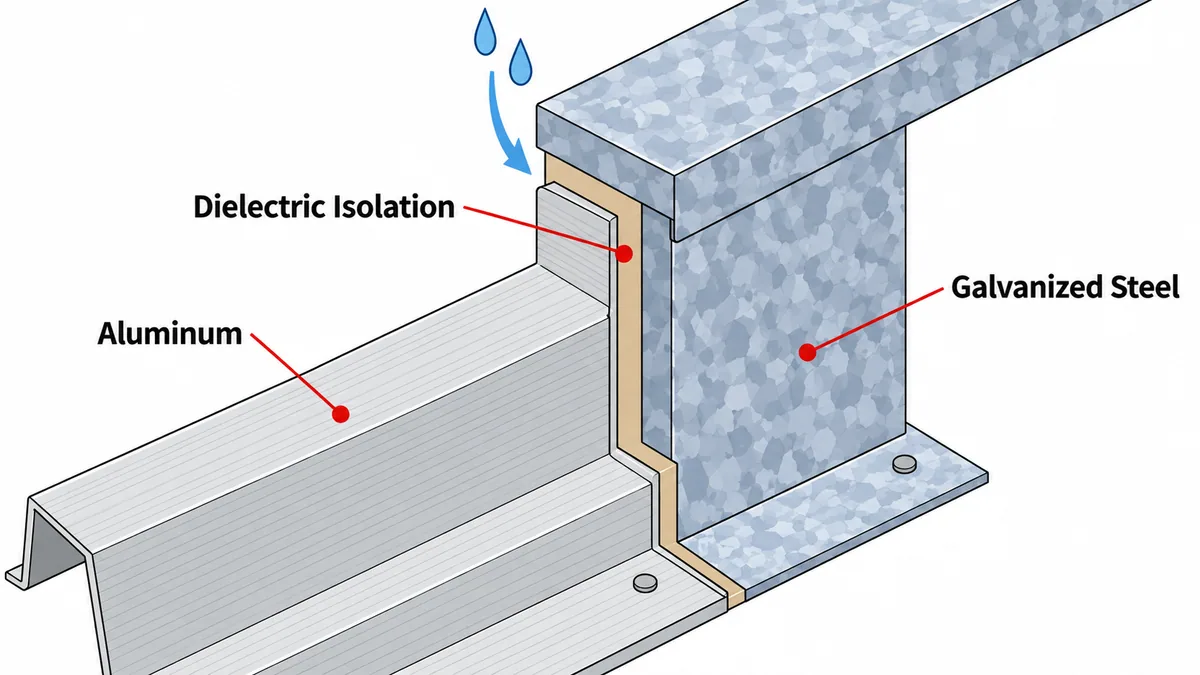
Galvanic compatibility is the other constraint at that same joint. Aluminum and galvanized steel sit far apart on the galvanic series, so poor galvanic compatibility between them means direct contact in the presence of moisture corrodes the joint at the contact line. A dielectric spacer or isolating gasket at any point where the two materials meet is the standard fix, worth confirming on any submittal where an aluminum-clad element meets a steel curb.
Frequently Asked Questions
Is a galvanized steel roof curb stronger than an aluminum one?
For an equivalent gauge, yes: steel’s tensile properties give it a structural edge, which is why it’s the default under continuously-running, heavy rooftop equipment.
What’s the difference between G60 and G90 galvanized coating?
The number is the total zinc weight per square foot across both sides of the sheet. G90 (0.90 oz/ft²) is the standard for full weather exposure; G60 (0.60 oz/ft²) is sheltered-installation only.
Can aluminum and galvanized steel curbs be used on the same roof?
Yes, but not in direct contact: any point where the two metals meet needs galvanic isolation (a dielectric spacer or gasket) to prevent contact-line corrosion.
Does a galvanized coating make a roof curb rust-proof?
No. Galvanizing slows corrosion by sacrificing the zinc layer first; it extends service life, it doesn’t eliminate corrosion risk indefinitely.
Does specifying aluminum instead of galvanized steel affect fabrication schedule?
It can. AWS D1.2, the welding code for aluminum, doesn’t permit prequalified welding procedures the way AWS D1.1 does for steel: every joint detail has to be individually qualified. A shop running standing steel welding procedures may need lead time to qualify an aluminum procedure before fabrication starts. Worth confirming with your supplier before switching materials on a schedule-sensitive job.
Ready to spec the right material for your build?
Send Custom Curb your unit specs and roof details: every curb is drawn in-house around the building’s actual conditions, no site visit required. Veteran-owned, family-operated, made in the USA.