Your first data center package arrives, and the owner’s documents call for Tier III, N+1 cooling, full commissioning, and behind-the-meter power. Mission critical construction terms are the shared vocabulary owners, engineers, and general contractors use to define how a facility must perform, how it is delivered, and how approvals and changes move through the contract. Most belong to a specific standards body or contract form, and on a data center job, that owner’s definition is the one your contract is read against.
What do Uptime’s Tier I–IV ratings actually require?
The Uptime Institute defines each Tier by outcomes, not equipment lists, and each includes everything in the Tier below it.
| Term | Definition |
|---|---|
| Uptime | Site-infrastructure performance: the outcome the Tier system was built to evaluate |
| Tier I: Basic Capacity | Dedicated IT space, UPS, after-hours cooling, and an engine generator |
| Tier II: Redundant Capacity | Adds redundant power and cooling components: UPS modules, chillers, pumps, generators |
| Tier III: Concurrently Maintainable | Adds a redundant power and cooling delivery path, so any component can be shut down for maintenance without affecting IT |
| Tier IV: Fault Tolerant | Equipment failures and path interruptions are stopped before they reach IT operations |
| TCDD | Tier Certification of Design Documents: Uptime’s review of the complete design set against the Tier Standard |
| TCCF | Tier Certification of Constructed Facility: a site visit and observed tests, ending in a full “pull the plug” test, to confirm the build matches the design |
The step from Tier II to Tier III is a second distribution path, not more equipment. Only Uptime Institute certifies Tiers. If the owner is pursuing TCCF, your installed work will be tested against the design before the owner receives the award.
How is N+1 different from 2N?
N is the capacity the critical load requires; every other figure describes what is installed beyond it.
| Scheme | What is installed |
|---|---|
| N | Exactly the capacity the load needs. No redundancy |
| N+1 | The required units plus one, so any single unit can be out of service |
| 2N | Two complete, independent systems, each able to carry the full load |
| 2N+1 | Two complete systems plus one additional unit |
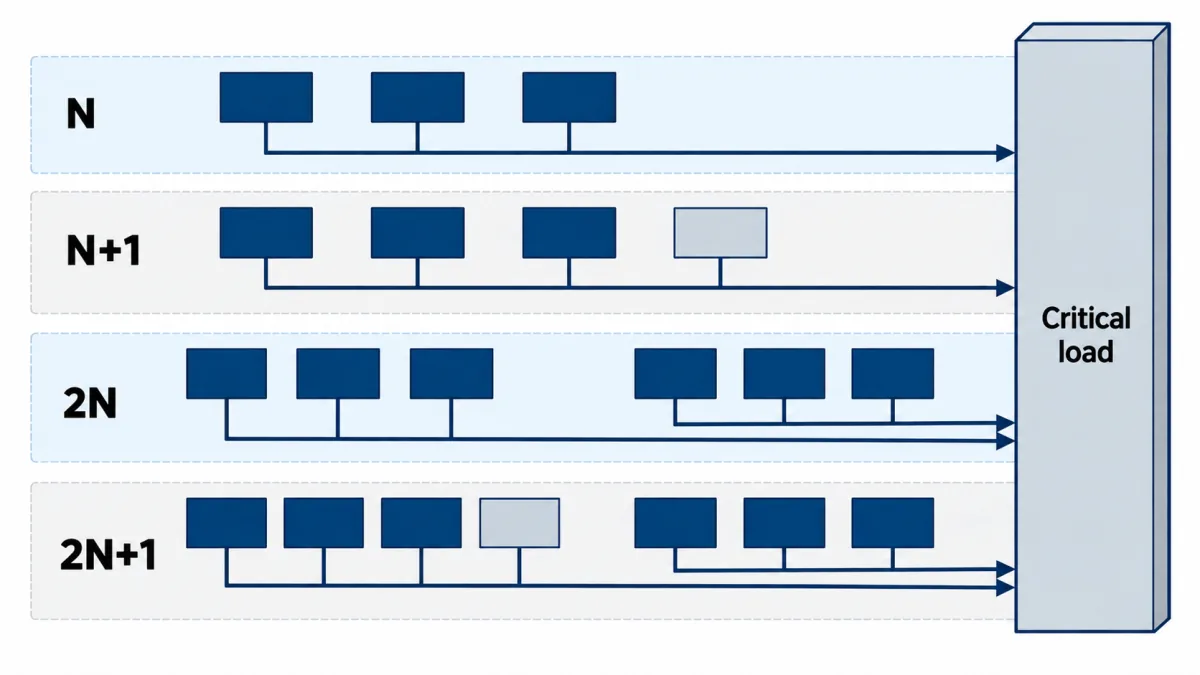
Redundancy count does not set the Tier. Uptime Institute notes that a Tier IV design is possible with N+1 components, depending on how they connect to redundant distribution paths.
Which delivery terms decide who carries design risk?
The delivery model tells you who owns the design, when the price is fixed, and how complete the drawings will be when you buy.
| Term | Definition | Source |
|---|---|---|
| Design-bid-build (DBB) | Three sequential phases (design, procurement, construction), usually ending in a sealed-bid, fixed-price contract | CMAA |
| Design-build (DB) | One entity, the design-builder, holds a single contract with the owner for design and construction | DBIA |
| CM at-Risk (CMAR) | The construction manager advises during design, then holds the trade subcontracts and construction risk as the legal equivalent of a general contractor | CMAA |
| Guaranteed maximum price (GMP) | A price for a fixed scope guaranteed not to exceed a stated maximum. Under CMAR it is usually set when design is 50 to 90 percent developed | CMAA |
| Integrated project delivery (IPD) | A multi-party agreement in which at least the owner, designer, and builder share risk and reward | CMAA |
| EPC | Engineering, procurement, construction: a turnkey form where the contractor takes total responsibility for design and execution | FIDIC Silver Book, 2017 |
| Fast-track | A schedule strategy, not a delivery method: construction packages release before the full design is complete | AIA Contract Documents |
On a fast-track or CMAR job, expect equipment selections to firm up after procurement starts.
Which performance and energy terms appear in the mechanical spec?
These terms define how systems are proven and how energy is judged, and both apply to the mechanical systems on your roof.
| Term | Definition | Source |
|---|---|---|
| Commissioning (Cx) | A quality-focused process for validating and documenting that facility elements meet the Owner’s Project Requirements (OPR) | ASHRAE Guideline 0-2019 |
| ASHRAE 90.4 | The energy standard written specifically for data centers, covering design, construction, and operation; it relies on ASHRAE 90.1 for the building envelope and lighting | ASHRAE, 2025 edition |
| PUE (power usage effectiveness) | Total facility energy divided by IT equipment energy; 1.0 is the theoretical floor | ISO/IEC 30134-2 |
PUE measures overhead, not total consumption. A lower PUE does not by itself mean the facility uses less energy, because the metric does not track growth in IT demand.
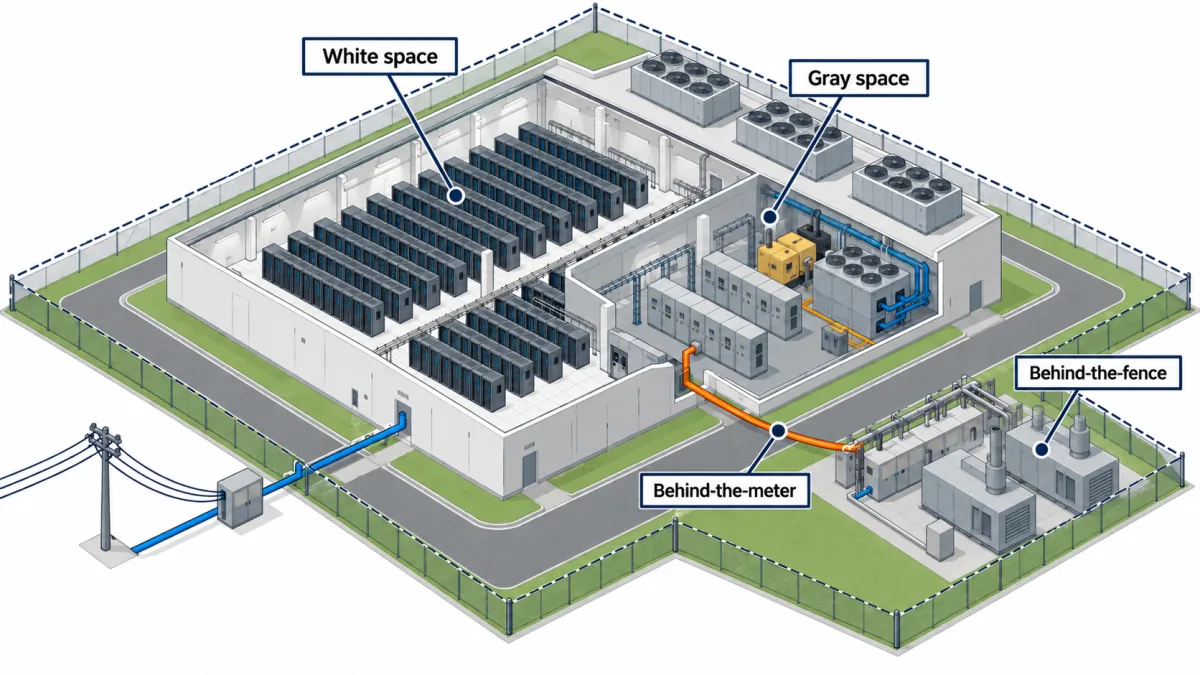
What do white space, gray space, behind-the-meter, and behind-the-fence mean?
The first pair divides the building by function; the second describes where power comes from.
| Term | Definition | Source |
|---|---|---|
| White space | Area housing revenue-producing IT equipment: servers, storage, network gear | Industry usage |
| Gray space | Mechanical and electrical support: generators, UPS, switchgear, chillers, transformers | Industry usage |
| Behind-the-meter | Generation that serves load without using the transmission system. Not off-grid: the generator can stay grid-connected | PJM tariff; FERC, 2025 |
| Behind-the-fence | Generation located on the facility’s own site; a location term, not a grid status | Industry usage |
Which contract terms control RFIs, submittals, and changes?
These terms move a question, a product, or a change through approval and onto the site.
| Term | Definition | Source |
|---|---|---|
| RFI (request for information) | The contractor’s prompt report of errors, inconsistencies, or omissions in the Contract Documents, in the form the architect requires | AIA A201-2017, §3.2 |
| Submittal | Shop drawings, product data, and samples prepared to illustrate a portion of the Work; not Contract Documents | AIA A201-2017, §3.12 |
| BIM coordination | Multi-party updating and checking of a shared digital model of the facility’s physical and functional characteristics | NIBS, NBIMS-US V3 |
| Change order | A written instrument signed by owner, contractor, and architect agreeing on the change, cost adjustment, and time adjustment | AIA A201-2017, §7.2.1 |
| Construction change directive (CCD) | A written order, signed by the owner, directing a change before cost or time adjustments are agreed | AIA A201-2017, §7.3.1 |
An RFI answer is not a price change. If a response adds cost or time, A201-2017 routes it through the claims process in Article 15.
For a fabricated rooftop component, the submittal is where a supplier’s engineering becomes reviewable. Custom Curb prepares its drawings in-house and provides installation drawings for its data center curbs, though it installs nothing.
How do these terms show up on the roof?
Several of these terms decide what the rooftop mechanical package, and the curbs under it, must deliver.
| Term | What it means on the roof |
|---|---|
| Tier III | Each rooftop unit must be serviceable while the others keep running. Our Tier-3 roof curb spec checklist covers what that asks of each curb |
| N+1 / 2N | The redundancy scheme sets the unit count, and every unit needs its own curb. Custom Curb designs each one from the HVAC manufacturer’s curb requirements for that specific unit, then fits it to the actual roof |
| Commissioning (Cx) | Installed mechanical systems are verified against the Owner’s Project Requirements, so the support under each unit is part of what gets checked |
Rooftop fans and compressors also generate vibration that can travel into the building. Spring isolation curbs absorb it at the roof instead; see how spring and rubber isolation compare.
Frequently asked questions
Does a Tier rating carry a guaranteed uptime percentage?
No. Uptime Institute removed expected-downtime figures in 2009, and its Tier Standard assigns no availability percentage to any Tier.
Is N+1 the same as Tier III?
No. N+1 counts capacity components. Tier III also requires a redundant distribution path, so each component can be maintained without affecting IT.
What is the difference between design-build and CM at-Risk?
Design-build puts design and construction under one contract. Under CM at-Risk, the owner holds the design contract separately, and the construction manager advises during design before taking construction risk.
Are approved shop drawings part of the contract?
Not under AIA A201-2017. Submittals are not Contract Documents, and approval does not cover a deviation the contractor failed to flag at submittal.
Read our data center buyer’s guide
Custom Curb designs and fabricates custom roof curbs and spring isolation curbs, shipped to your site as a material supplier. Before you specify, read our data center buyer’s guide.