
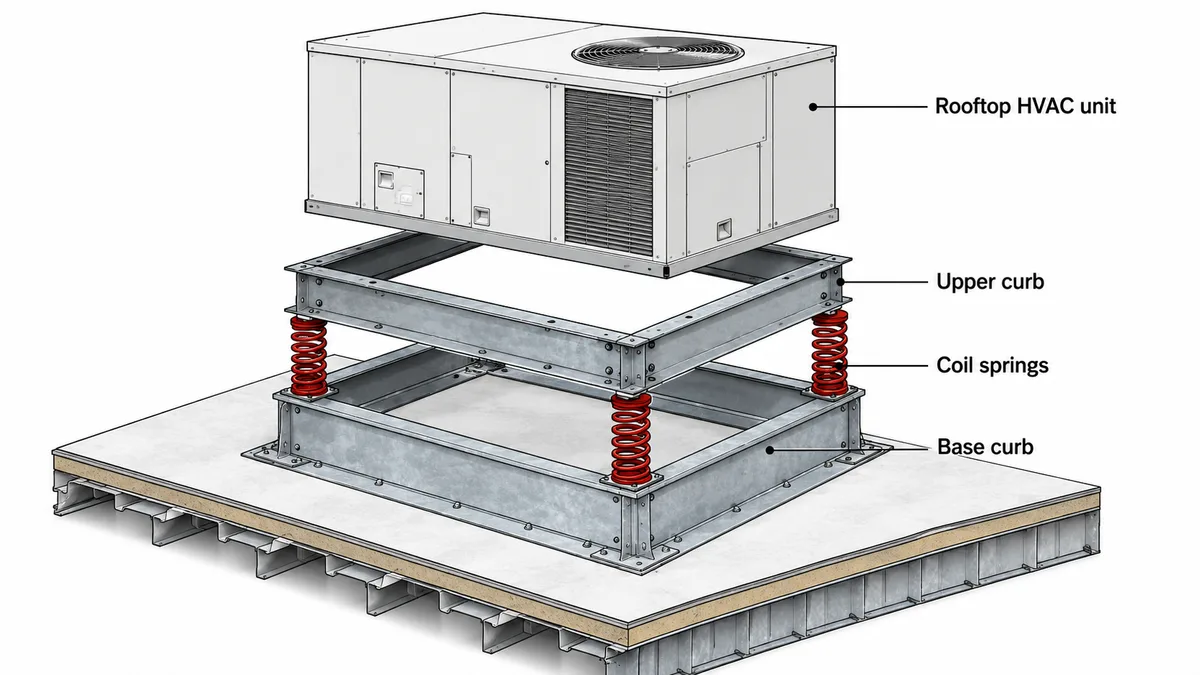
A spring isolation curb is a two-piece roof curb that supports a rooftop HVAC unit on a layer of steel coil springs, absorbing the equipment’s vibration before it enters the building structure. When properly sized, a spring isolation curb achieves isolation efficiency of 90% or greater, meaning 90% or more of the mechanical vibration generated by the equipment is absorbed at the curb rather than transmitted into the roof and building below.
How Is a Spring Isolation Curb Different from a Standard Roof Curb?
A standard roof curb is a rigid structural frame, typically galvanized steel, that anchors the HVAC unit to the roof deck and provides a weather-sealed penetration through the roof surface. It supports the equipment’s weight and transfers loads directly into the roof structure. Vibration generated inside the unit transmits through that rigid connection into the building.
A spring isolation curb replaces the rigid connection with a tuned spring system. The two-piece construction separates the load-bearing curb into:
- Base curb: fastened to the roof deck; anchors the assembly and seals the roof penetration.
- Upper curb: supports the HVAC unit; floats on the spring layer above the base.
- Coil springs: positioned between the base and upper curb; absorb rotating-equipment vibration at the source.
The HVAC unit and upper curb move together. The base curb stays fixed to the structure. The springs are the only mechanical connection between them.
Why Does HVAC Vibration Matter?
Every rooftop HVAC unit contains rotating equipment (fans, compressors, scroll components) that generates mechanical vibration during normal operation. In a rigidly mounted curb, that vibration travels through the curb, through the roof structure, and into the building as structure-borne noise: the low-frequency hum audible and measurable in occupied spaces below.
The consequences are practical, not theoretical. Structure-borne vibration causes occupant discomfort in commercial spaces, creates interference in electronic-sensitive environments, and accelerates fatigue in the building structure and HVAC equipment itself over time.
The critical variable is not equipment weight: it is the equipment’s operating RPM. Rotating equipment produces a disturbing frequency tied directly to its shaft speed. Typical rooftop CRAC units, air-handling units (AHUs), and packaged systems operate in frequency ranges that couple efficiently with commercial roof structures, making isolation selection a function of that disturbing frequency, not just the load.
What Deflection Level Do You Need?
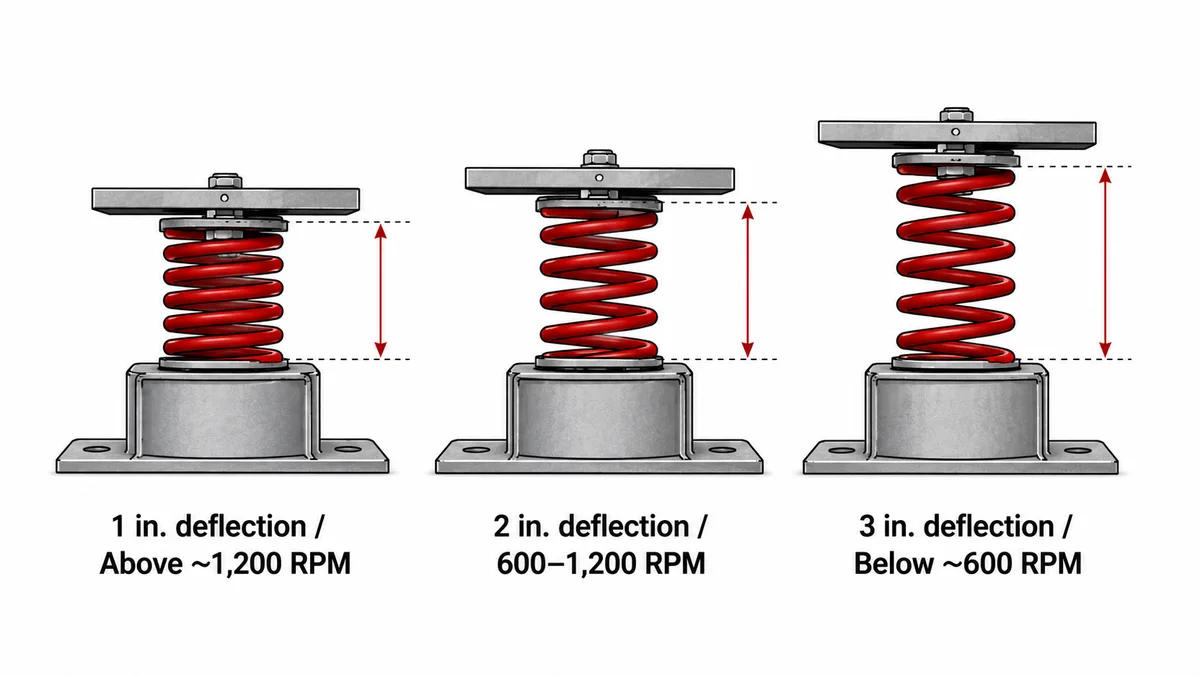
Deflection is the distance a spring compresses under load, and it determines how well the spring system isolates the equipment’s specific operating frequency. The ASHRAE Handbook provides guidance for minimum static deflection based on the equipment’s disturbing frequency. The general application framework used in mechanical engineering practice is:
| Spring Deflection | Applicable Disturbing Frequency Range | Typical Equipment |
|---|---|---|
| 1 inch | Above approximately 1,200 RPM | Packaged AHUs, smaller fans |
| 2 inches | Approximately 600–1,200 RPM | Larger packaged systems, CRAC units |
| 3 inches | Below approximately 600 RPM | Low-speed equipment, large chillers on curbs |
A useful practical note: rubber and neoprene isolation pads can adequately control low-amplitude, high-frequency vibration. Steel coil springs, by contrast, achieve the deflection levels necessary to address the lower-frequency, higher-amplitude vibration that rotating commercial HVAC equipment produces, which is why spring isolation is the specified approach in acoustically sensitive applications. A comparison of spring and rubber isolation performance is covered in a separate post in this series.
When Is a Spring Isolation Curb Required?
A spring isolation curb is the appropriate product when the occupied space below a rooftop HVAC unit has a zero-tolerance threshold for structure-borne vibration or noise. Common applications include:
- Mission-critical and data center facilities: where continuous HVAC operation is required for equipment uptime and where sensitive electronics occupy the spaces below rooftop cooling systems.
- Occupied commercial space directly beneath rooftop HVAC: conference rooms, executive suites, and similar spaces with high acoustic standards.
- Light structural framing: roofs with open web joists, long-span slabs, or thin construction amplify rather than absorb vibration. Equipment over 300 lb on these roof types should be evaluated for isolation.
- Low-RPM, high-load equipment: where the disturbing frequency is low enough that only a 2" or 3" deflection spring system achieves the required isolation efficiency.
A standard rigid curb handles structural support and weather sealing, and it does those jobs correctly. When the mechanical design calls for vibration isolation, the spring isolation curb is the fabricated product that delivers it.
Frequently Asked Questions
What is a spring isolation curb?
A spring isolation curb is a two-piece roof curb assembly that supports a rooftop HVAC unit on calibrated steel coil springs, isolating the equipment’s mechanical vibration from the building structure. The base curb anchors to the roof; the upper curb floats on the spring layer and carries the HVAC unit.
How effective is a spring isolation curb at controlling vibration?
When properly sized to the equipment’s operating frequency, a spring isolation curb achieves 90% or greater isolation efficiency, meaning 90%+ of the mechanical vibration generated by the equipment is absorbed rather than transmitted into the building structure.
What deflection level do I need for a rooftop CRAC unit?
Deflection selection depends on the equipment’s operating RPM and disturbing frequency. As a starting point, ASHRAE guidance points to approximately 2" deflection for equipment in the 600–1,200 RPM range, which covers many commercial CRAC and packaged AHU configurations. A mechanical engineer should verify against the specific unit’s cut sheet. Sizing guidance for specific applications is covered in depth in a separate post on spring isolation deflection selection in this series.
Can I use a rubber or neoprene pad instead of a spring isolation curb?
Rubber and neoprene isolation pads control high-frequency, low-amplitude vibration adequately in low-sensitivity applications. They cannot achieve the deflection levels required to address the lower-frequency vibration produced by large rotating rooftop HVAC equipment, and they are subject to compression set over time. Spring isolation is the standard specification for mission-critical and acoustically sensitive applications.
Does a spring isolation curb require a special installation process?
The two-piece assembly is shipped with the base and upper curb as a coordinated set. The base curb installs into the roof deck first; the upper curb and spring assembly are set above it before the HVAC unit is craned into position. Custom Curb provides installation drawings with every order. If you have questions during installation, our team is available directly by phone.