
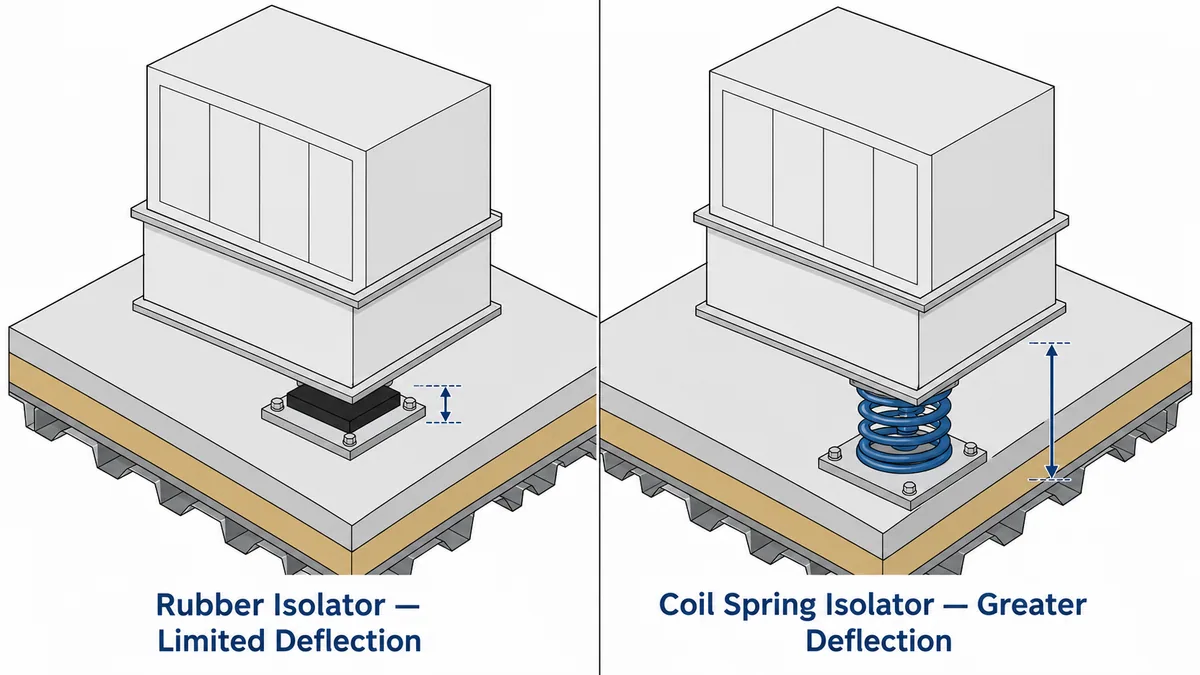
Spring isolation and rubber (elastomeric) isolation are the two vibration-isolation methods used under rooftop HVAC equipment, and the choice comes down to one variable: how much static deflection the equipment’s operating frequency requires. Metal coil springs can achieve several inches of deflection; compressed rubber or neoprene pads are limited to a fraction of an inch, and that gap is what determines how much vibration each method actually removes.
How Rubber (Elastomeric) Isolation Works
A rubber isolator, usually neoprene, absorbs vibration by compressing under load. Because rubber has meaningful internal damping, it’s genuinely effective at killing high-frequency noise and buzz: the kind that travels through a structure as an audible hum rather than a physical shake. Its limitation isn’t the material’s quality; it’s geometry. Elastomeric pads can only compress so far before they lose their working range, which caps how low their natural frequency can go.
How Metal Coil-Spring Isolation Works
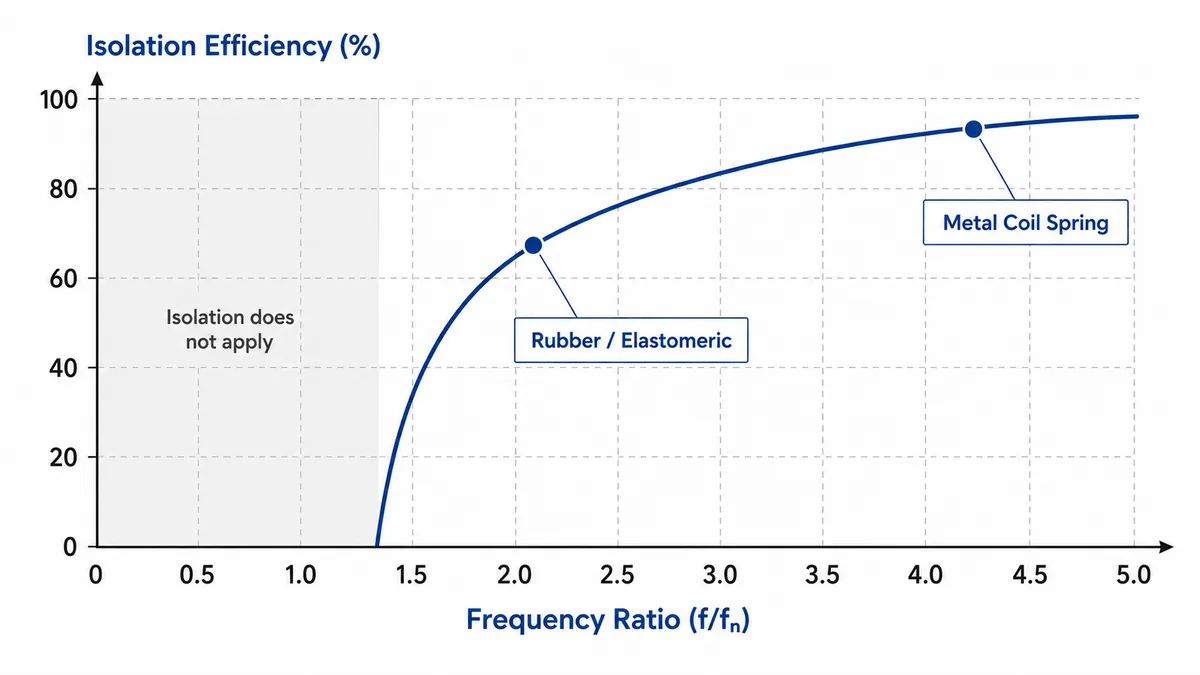
A coil spring works on the same physics, with one structural advantage: it can deflect several inches instead of a fraction of one. Greater static deflection lowers the isolator’s natural frequency, and the wider the gap between that natural frequency and the equipment’s actual operating (disturbing) frequency, the more of the vibration gets isolated rather than transmitted. That deflection-to-frequency relationship, not the spring itself, is what the ASHRAE Handbook’s sound and vibration control guidance is built around, the same reason rooftop equipment specs are written around deflection and frequency ratio rather than material choice alone.
Isolation Efficiency, Deflection, and Longevity: Head to Head
| Factor | Rubber / Elastomeric | Metal Coil Spring |
|---|---|---|
| Typical deflection range | Fraction of an inch | 1–3+ inches |
| Damping characteristic | High internal damping | Low damping: near-free oscillation |
| Isolation efficiency (properly sized) | Effective above roughly 1,800–3,600 RPM; drops off for lower-RPM equipment | 90% or greater at the equipment’s operating frequency, when deflection is matched to that frequency |
| Best-suited frequency range | High-frequency, lighter equipment | Low-to-mid frequency, heavier rotating/reciprocating equipment |
| Environmental durability | Degrades with UV exposure and thermal cycling on exposed rooftops | Steel is largely unaffected by UV; needs a corrosion-resistant finish for rooftop exposure |
| Relative cost | Lower unit cost | Higher unit cost, offset by wider applicability |
Best For / Avoid If
| Best for | Avoid if | |
|---|---|---|
| Rubber isolation | Small, high-RPM equipment where noise, not low-frequency vibration, is the concern | Equipment operates below roughly 1,800 RPM, or the spec calls for a stated isolation-efficiency threshold |
| Spring isolation | Rooftop RTUs, CRAC/CRAH units, and other heavier, lower-RPM equipment common on mission-critical roofs | Budget-only decisions with no operating-frequency data to size against, since undersizing deflection wastes the spring’s advantage |
On a mission-critical roof, the stakes for getting this right are higher than on a standard commercial building: N+1 cooling groups mean more units running continuously near structure that can’t absorb resonance, which is why isolation efficiency shows up as a named line item on a Tier-3 spec rather than an assumed default.
Custom Curb’s spring isolation curbs are built as a two-piece assembly (a base curb and an upper curb with coil springs between them) engineered in-house from the HVAC manufacturer’s curb requirements and the building’s actual roof conditions, including pitch correction when the roof isn’t flat. That’s a different starting point than selecting an isolator off a catalog page: the curb and the isolation are designed together, not added on after the fact.
Frequently Asked Questions
Is rubber isolation ever the right choice for rooftop HVAC?
Yes, for smaller, higher-RPM equipment such as exhaust fans, where the concern is high-frequency noise rather than low-frequency structural vibration. It’s the wrong choice once equipment RPM drops and deflection requirements exceed what a rubber pad can provide.
Why can’t a thicker rubber pad match a spring’s deflection?
Elastomeric material stiffens as it compresses, so adding thickness doesn’t scale deflection linearly the way a coil spring’s geometry does. Past a certain point, a thicker pad doesn’t isolate meaningfully better; it just costs more.
What isolation efficiency should a spring isolation curb achieve?
Properly sized spring isolators typically deliver 90% or greater isolation efficiency at the equipment’s actual operating frequency. Some mission-critical specs set a tighter minimum threshold specifically to close substitution loopholes; see our guide to writing that spec language for how that number gets written into a project spec.
Does switching from rubber to spring isolation require a different curb?
Generally yes: spring isolation curbs are a two-piece assembly with springs between a base and upper curb, engineered differently from a curb built to carry a rubber pad. Our spring isolation curbs overview covers that construction.