

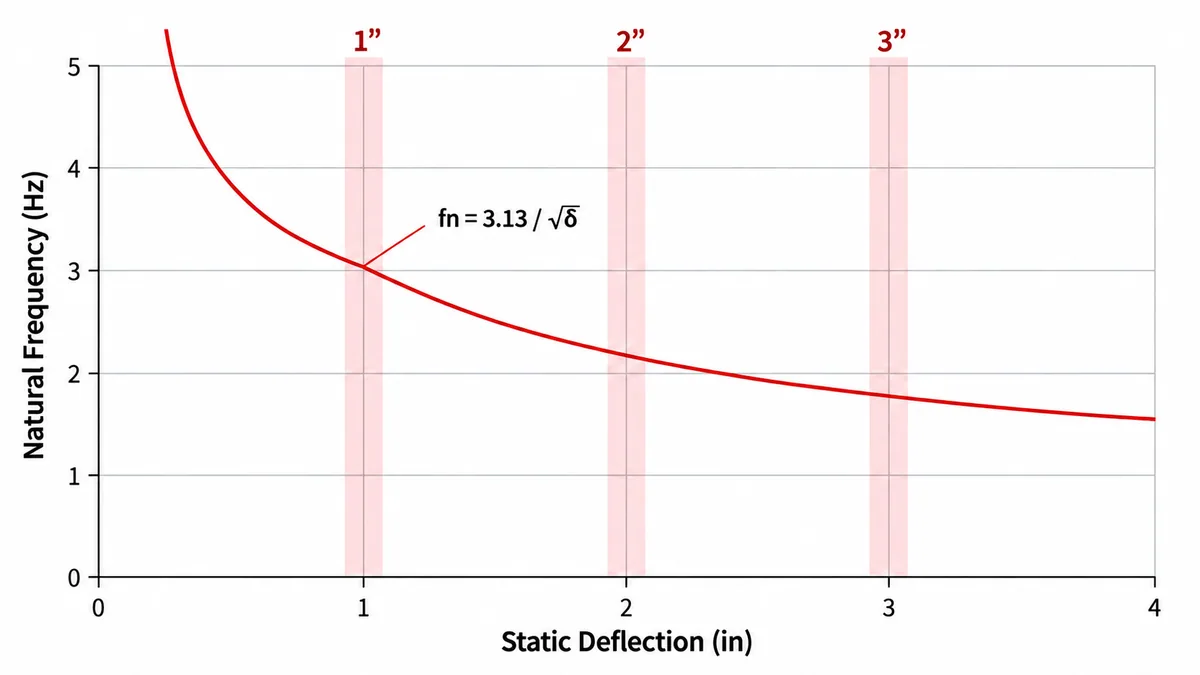
Spring deflection sizing is the process of matching a spring isolator’s static deflection to the disturbing frequency of the HVAC equipment it supports, using the relationship fn = 3.13/√δ (natural frequency in Hz, deflection in inches) to keep the isolator’s natural frequency far enough below the equipment’s operating frequency to achieve the target isolation efficiency.
A spring isolation curb uses coil springs between a base curb and an upper curb to isolate rooftop equipment vibration; deflection is what makes that isolation work at a specific frequency, not just in general. The practical breakpoints set the range: 1" deflection above roughly 1,200 RPM, 2" for 600–1,200 RPM, 3" below roughly 600 RPM. What follows is how to actually get from a unit’s cut sheet to the right number.
What Static Deflection Actually Measures
Static deflection is the distance a spring compresses under its rated load at rest, not a spring “softness” rating. It’s the input to one formula: fn = 3.13/√δ. A spring deflecting 1" under load has a natural frequency near 3.13 Hz (188 CPM); at 3" deflection, that drops to roughly 1.8 Hz. Lower natural frequency means a wider gap between the isolator and the equipment’s disturbing frequency, and that gap, expressed as the frequency ratio, is what isolation efficiency is actually a function of. (For equipment where rubber isolation, not springs, is the better-suited method, see our comparison of the two isolation types.)
Sizing to RPM: the Frequency Ratio, Not Just the Table
Operating RPM converts directly to disturbing frequency (RPM ÷ 60 = Hz for a 1x rotational component). Isolation efficiency isn’t binary: it climbs as the frequency ratio (disturbing frequency ÷ natural frequency) rises past roughly 1.4, and the deflection tiers exist to push that ratio comfortably past the point where isolation efficiency clears 90%. That’s why a 1,000-RPM unit sitting on a 1" mount can still underperform even though 1,000 RPM sits near the “above 1,200” tier: the ratio matters more than which side of a round-number line the RPM falls on. Run the actual number, don’t just match to the nearest bracket.
A worked example: Take a rooftop CRAC unit rated at 900 RPM, read off its equipment cut sheet. Disturbing frequency: 900 ÷ 60 = 15 Hz. For a 2" deflection mount, fn = 3.13/√2 ≈ 2.21 Hz. Frequency ratio: 15 ÷ 2.21 ≈ 6.8, well past the ~1.4 threshold where isolation begins, placing this selection solidly in the 90%+ efficiency range the 600–1,200 RPM tier targets. That’s the check to run before signing off on a vendor-proposed deflection, not just confirming the RPM falls in the right bracket.
Does Deflection Sizing Change for VFD-Driven Equipment?
Yes: size to the lowest operating RPM in the turndown range, not the nameplate or maximum speed. Equipment running on a variable-frequency drive doesn’t hold one RPM; it modulates across a range, and disturbing frequency modulates with it. A lower operating RPM produces a lower disturbing frequency, which is the worst case for the frequency ratio and isolation efficiency. Sizing to maximum RPM alone can leave a unit undersized exactly at the low-speed condition where it spends significant runtime. Confirm the turndown range on the cut sheet alongside RPM and weight before finalizing deflection.
Size to the Loaded Weight at Each Mount, Not the Average
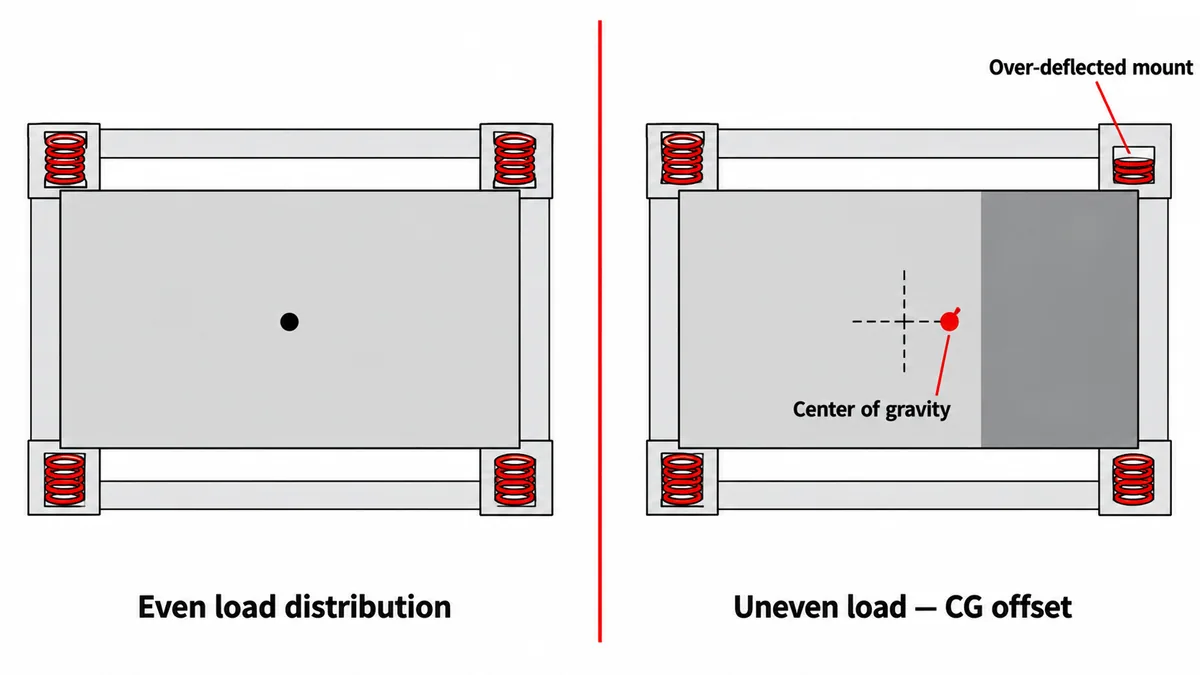
Springs must be selected for the actual load carried at each individual mount point, not the equipment’s total weight divided evenly by mount count. Most rooftop units don’t distribute weight evenly across their footprint: compressors, coils, and fan assemblies cluster mass off-center. A mount under the compressor bay can carry meaningfully more than one under the empty condenser section (the same cut sheet used for RPM gives the weight distribution data needed to catch this), and sizing every mount to the “average” leaves the heaviest-loaded spring over-deflected, with its own natural frequency drifting out of the range the design assumed.
Custom Curb designs each spring isolation curb in-house, starting from the HVAC manufacturer’s curb requirements and the unit’s actual weight distribution rather than a generic deflection chart, which is what makes per-mount, CG-aware sizing possible instead of optional.
Common Spring Deflection Sizing Mistakes
- Undersizing heavy, low-RPM equipment. The mistake that costs the most isolation efficiency: assuming a 2" mount is “close enough” for equipment that needs 3" because it’s heavy, when RPM, not weight, is what should be driving tier selection.
- Mismatching deflection to spring count. Adding more mounts to carry a heavier unit changes the load per mount, which can shift which deflection tier is correct; it doesn’t hold the original sizing constant.
- Ignoring center-of-gravity offset. Sizing every mount identically without checking the unit’s CG location produces the uneven-loading problem above, and it’s the mistake most likely to pass an initial review and show up as measured vibration after startup.
Getting deflection right at design coordination is cheaper than a field retrofit after commissioning shows the unit isn’t isolating as specified. On a mission-critical or data center roof, where N+1 cooling groups keep multiple units running continuously near structure that can’t absorb resonance, undersized deflection is the difference between a spec that clears review clean and one that surfaces as a vibration complaint after the facility is live.
Frequently Asked Questions
What deflection do I need for a 900 RPM rooftop unit?
900 RPM falls in the 600–1,200 RPM range, which generally calls for 2" deflection. The worked example above shows this checks out at a frequency ratio of roughly 6.8, well past the isolation threshold. Confirm against per-mount loaded weight before finalizing.
Why does deflection matter more than spring stiffness alone?
Deflection is the direct input to natural frequency (fn = 3.13/√δ); stiffness only matters through its effect on how much a given load deflects that specific spring.
Can I use the total unit weight divided by the number of mounts to size deflection?
No. Springs need to be sized to the actual loaded weight at each mount point, since most equipment doesn’t distribute weight evenly across its footprint.
Does deflection sizing change for seismic zones?
Deflection sizing and seismic restraint are separate calculations: a correctly sized spring still needs restraint hardware rated for the applicable wind/seismic loads under ASCE 7.