
A roof curb specification that doesn’t name welding standard, gauge, pitch tolerance, and isolation threshold isn’t a specification. It’s an invitation to substitute. A defensible roof curb spec in CSI MasterFormat Section 07 72 46 states performance criteria precisely enough that “or equal” has nothing to attach to. That’s the standard this post writes to: twelve phrases you can paste into a project spec today, each tied to a code or standard, organized by where they belong in the section.
This isn’t a lecture on why specs matter. You already know that. It’s the language.
Why Spec Language Is the Real Substitution Battleground
Most curb substitution fights aren’t won or lost during design. They’re won or lost at the 60% review, when a contractor’s value-engineering proposal lands on your desk asking to swap a fully welded, pitch-corrected curb for an “or equal” that meets the same general description but skips the parts that cost money. On a commercial building, a weak spec means a callback. On mission-critical facilities such as data center construction, it means a curb that has to perform for the life of the building with no second chance to get it right.
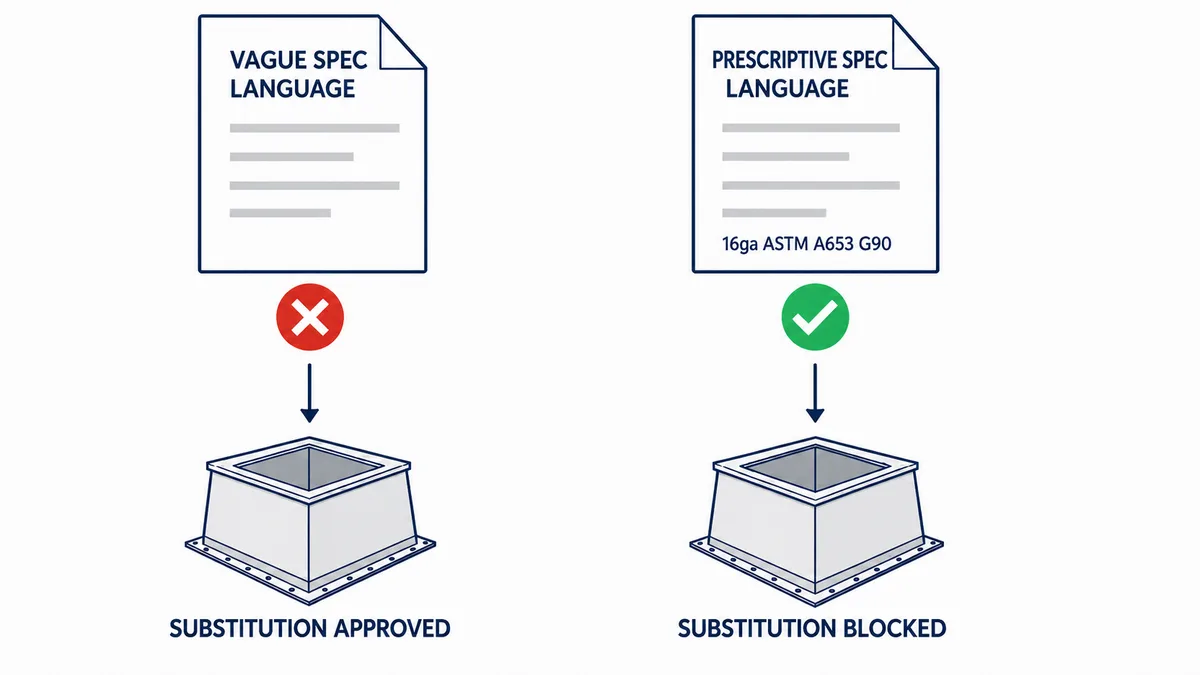
If your spec said “roof curb, 16-gauge minimum, fully welded per AWS D1.3,” that VE request has nowhere to go. If it said “roof curb as required for unit,” it sails through, because nothing in the spec says it can’t.
The fix isn’t writing more spec. It’s writing tighter spec: phrases that name a standard, a number, or a code section, not an adjective.
Where Curb Specs Belong: 07 72 46, Not 07 72 00
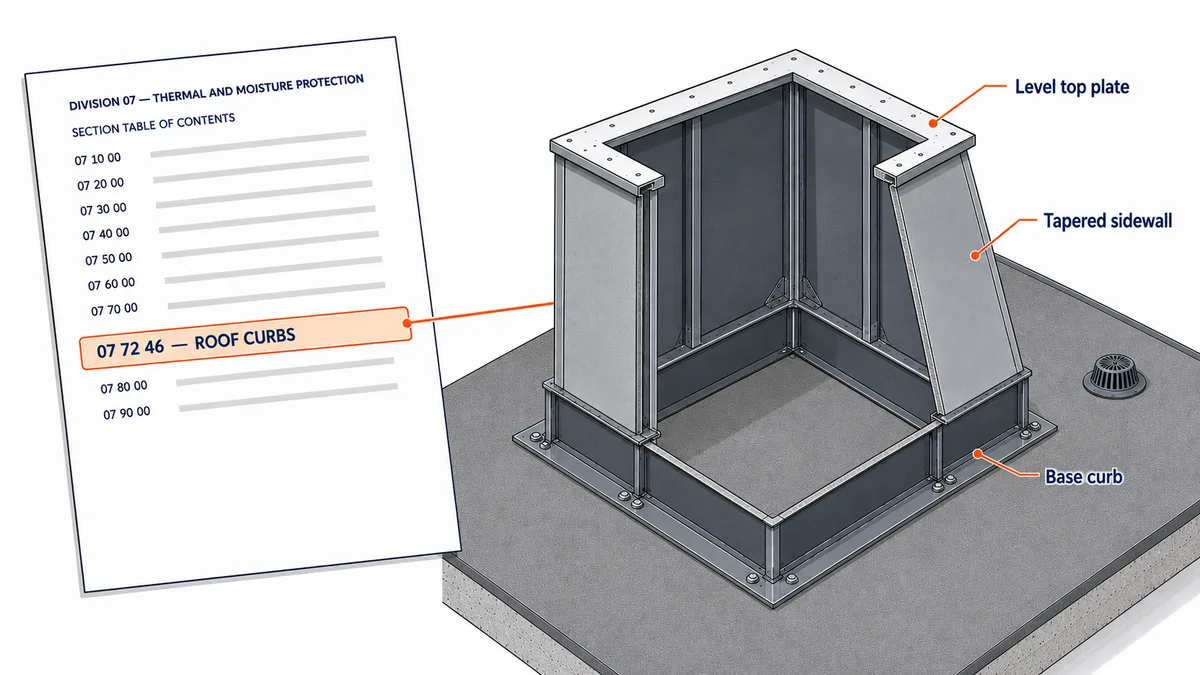
Roof curbs have their own CSI MasterFormat 2020 section: 07 72 46, Roof Curbs. The broader “07 72 00, Roof Accessories” heading is sometimes used loosely by mechanical engineers defaulting to a general accessories section, and that’s the first substitution risk, because a vague section heading invites a vague spec. Naming 07 72 46 specifically signals to the contractor and reviewer that the curb is a distinct, engineered scope, not an accessory line item.
The 12 Spec Phrases
The table below gives copy-paste language for each requirement category, the standard it cites, and where it lives in a typical 07 72 46 section.
| # | Spec category | Sample phrase | Standard cited | Spec location |
|---|---|---|---|---|
| 1 | Welding | “Curb shall be fully welded construction per AWS D1.3, Structural Welding Code – Sheet Steel; stitch or spot welding not acceptable.” | AWS D1.3 | Part 2, Fabrication |
| 2 | Gauge/Material | “Base and sidewall construction minimum 16-gauge galvanized steel, ASTM A653, G90 coating.” | ASTM A653 | Part 2, Materials |
| 3 | Pitch Correction | “Top plate shall be level to ±1/8 inch regardless of roof slope; tapered sidewall construction required for slopes exceeding 1:12.” | Practitioner tolerance convention | Part 2, Fabrication |
| 4 | Isolation Efficiency | “Where vibration isolation is specified, curb shall provide minimum 95% isolation efficiency at equipment operating frequency.” | ASHRAE transmissibility framework | Part 2, Performance |
| 5 | Attachment | “Curb-to-roof attachment shall be engineered for the project’s wind and seismic design criteria per ASCE 7.” | ASCE 7 | Part 2, Performance |
| 6 | Submittal Turnaround | “Manufacturer shall provide stamped shop drawings within [X] business days of order to support project submittal schedule.” | AIA A201 submittal procedures | Part 1, Submittals |
| 7 | Weatherproofing | “All seams and penetrations shall be continuously welded and sealed; no field-applied sealant as a substitute for welded construction.” | Industry practice | Part 2, Fabrication |
| 8 | Insulation R-Value | “Insulated curbs shall meet or exceed R-[value] per ASHRAE 90.1 building envelope requirements.” | ASHRAE 90.1 | Part 2, Materials |
| 9 | Equipment-Specific Dimensions | “Curb dimensions shall match the selected unit manufacturer’s published curb cap requirements exactly; field modification not acceptable.” | Manufacturer cut sheet coordination | Part 1, Coordination |
| 10 | Certification | “Welding shall be performed by AWS-certified welders; fabricator shall provide welder certification documentation upon request.” | AWS certified welder program | Part 1, Quality Assurance |
| 11 | Cricket/Drainage | “Curbs exceeding 30 inches in width on the uphill side shall include a cricket sized to direct water around the curb perimeter.” | IBC Section 1503.5, NRCA roof drainage guidance | Part 2, Fabrication |
| 12 | Supplier Accountability | “Fabricator shall remain the single point of contact for design, fabrication, and field installation questions through project closeout.” | Industry practice | Part 1, Quality Assurance |
A note on what these phrases don’t do: they don’t name a manufacturer, a brand, or a “basis of design” product. Performance-based language survives review and survives substitution attempts equally. That’s the design intent of writing this way.
Where Each Phrase Lives in the Spec Coordination Cycle
Most projects move through spec development in 30-60-90% coordination reviews. Performance and material phrases (categories 1–5, 8) are typically locked by the 60% review, since they affect structural and mechanical coordination. Submittal, certification, and accountability language (categories 6, 10, 12) is usually finalized by 90%, once the project schedule and procurement approach are set. Writing the prescriptive phrases early, at 30%, gives them the best chance of surviving later VE passes, because removing language that’s already coordinated across disciplines is harder than removing language that was never locked in.
How This Spec Language Holds Up Under Value-Engineering Review
A VE substitution request has to argue the proposed alternate meets spec. Every phrase above is written so that argument requires the alternate to match a named standard, not just a general description. “16-gauge galvanized steel per ASTM A653” doesn’t admit an 18-gauge “or equal” no matter how the submittal package frames it. That’s the entire mechanism: performance criteria with no interpretive room.
This is also why generic phrases like “heavy-duty construction” or “industrial-grade” do the opposite of what they sound like: they read as quality language but function as the loosest possible spec, because nothing in them can be measured or enforced.
FAQ
What CSI MasterFormat section covers roof curbs?
Roof curbs are covered under Section 07 72 46, Roof Curbs, a distinct section from the broader 07 72 00 Roof Accessories heading.
Why does “or equal” language create substitution risk?
“Or equal” without stated performance criteria lets a contractor argue any product meeting a general description qualifies, even if it’s lighter-gauge, spot-welded, or missing pitch correction. Naming specific standards and numeric thresholds closes that gap.
What welding standard applies to roof curb fabrication?
Most roof curb fabrication falls under AWS D1.3, Structural Welding Code – Sheet Steel, which covers sheet steel construction, as distinct from AWS D1.1 for heavier structural steel.
Does this spec language change for mission-critical facilities like data center construction?
The baseline phrasing is the same: gauge, welding standard, and pitch correction don’t change because the building behind them is mission-critical. What typically gets added is isolation-efficiency and seismic/wind restraint language, governed by a separate spec section (CSI 23 05 48) rather than 07 72 46.
When in the design process should this spec language be locked in?
Ideally by the 30% coordination review, before later value-engineering passes make prescriptive language harder to add back in.